


|
|  | |
| Tokamak Fusion Test Reactor at Princeton Plasma Physics Laboratory and view of plasmas within torus during operation. |
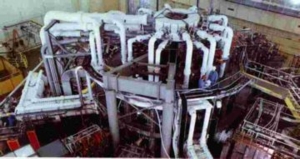
Magnetic confinement fusion devices are designed to confine hot, dense plasma for a sufficient period of time (a few seconds) for nuclei to fuse by overcoming their natural repulsive forces. An operating fusion energy reactor must attain sufficiently high energy density for the fusion to become self-sustaining (ignition) and generate economically significant energy gains.
Due to the coupling of ionized particles and fields, any plasma system exhibits coherence and must be treated as an interactive system and not simply as an aggregate of parts. In plasma systems, a wide variety of forces and instabilities can oppose efforts at confinement. Nevertheless, basic research has enabled experiments that are 1,000,000 times better in overall performance than devices used only 20 years ago. Fusion is routinely produced in current experiments and we are now on the threshold of "burning plasma" experiments that will allow the construction of useful fusion powers plants.
- Frequently used terms; fusion and plasma FAQ and Glossary
- Fusion Power Associates with timely newsletter on fusion issue
- National Fusion Energy Science
national, interactive information repository, draft roadmap for fusion energy, education material, technical information, policy, fusion collaborations
U. S. University Research Centers
Research Laboratories Worldwide (non-U.S.)
Major Fusion Centers- International Thermonuclear Experimental Reactor (ITER)
international collaboration for design and implementation of fusion reactor tests at the level of a commercial power station, ITER explanations, collaborations, fusion research - DOE Office of Science and Office of Fusion Energy Sciences
fusion research laboratories worldwide, fusion calendar, fusion documents, fusion and the environment, fusion energy sciences advisory committee - Princeton Plasma Physics Laboratory Princeton University, Princeton, New Jersey
f usion physics, MHD stability, transport, reactor wall conditioning, magnetic reconnection studies, beam-surface interaction studies, theoretical plasma physics, plasma confinement, confinement, wave-heating methods, edge physics, plasma transport, fusion research projects and experiments - UK Fusion Center at Culham (UKAEA) Oxfordshire, United Kingdom
tokamak fusion studies, experiments: Joint European Torus JET, tokamak COMASS-D, spherical tokamak START, mega-amp spherical tokamak MAST - Joint European Torus, Culham, Oxfordshire, United Kingdom
tokamak JET project information, experiment: JET - Institute for Plasma Physics (one of 16 Helmholtz research centers) Julich, Germany Center for Trilateral Euregio Cluster (TEC), experiments: Tokamak TEXTOR-94
- Max-Planck-Institut fur Plasmaphysik, Garching, Germany
fusion plasma research, confinement, heating and refuelling, diagnostics, plasma-wall interaction, plasma theory, experiments: tokamak ASDEX Upgrade, stellarator WENDELSTEIN 7 - Commissariat a L'Energie Atomique Assoc. Euratom-CEA, Paris, France
fusion research, ITER and JET collaborations, FAQ, news, conferences, what's new,
fusion tutorial - science, history, safety, economics. - Japan Atomic Energy Research Institute JAERI
tokamak fusion plasmas, plasma heating and confinement experiments: large tokamak device JT-60 - National Institute for Fusion Science NIFS, Toki City, Japan
fusion studies, tokamaks, helicals, transport, equilibrium, stability, nonlinear phenomena, numberical codes, sawtooth oscillation, RFP multipinch device modeling, field line chaos, experiments: large helical device LHD experiment CHS - National Fusion R&D Center, Korea
Korean superconducting Tokamak reactor KSTAR
 section top
  page top
U. S. Research Laboratories emphasizing fusion
- Fusion Power Program, Argonne National Laboratory, Argonne, Illinois
nuclear system design, materials research and development, blanket technology - General Atomics Fusion Group, San Diego, California
tokamak research, diagnostics, transport and equilibrium codes, National Fusion Facility
experiment: DIII-D - LANL Fusion Energy Program Office, Los Alamos Scientific Laboratory,
Los Alamos, New Mexico
alternate confinement projects, Penning fusion experiment, magnetized target fusion - Fusion Energy Division, Oak Ridge National Laboratory Oak Ridge, Tennessee
magnetic fusion energy development. toroidal confinment, fusion theory, modeling, MHD, transport, RF heating/current drive, plasma edge effects, stellerator research, diagnostic systems, plasma spectroscopy - Princeton Plasma Physics Laboratory Princeton University, Princeton, New Jersey
(described in Major Fusion Centers above)
page top
- Auburn Physics Department, Auburn University, Alabama
fusion plasmas, wave resonance heating, diagnostics, nonlinear plasma dynamics
experiment: compact Auburn torsatron CAT - Applied Science Department, University of California, Davis
(plasma science and fusion engineering) laser-plasma physics, x-ray lasers, plasma spectroscopy, plasma diagnostics, inertial confinement fusion (ICF), compact torus injection, beam physics, (microwave and millimeter wave technology) microwave plasma interactions, self field generation, parametric instabilities, stimulated Brillouin scattering, resonance absorption in microwave plasma interaction, fusion diagnostics
experiments: high brightness electron accelerator (LLNL) high power gyrotron and free electron laser labs (LLNL) Davis Diverted Tokamak DDT (LLNL), fusion plasma diagnostics laboratory (Davis), microwave source and plasma interaction lab (Davis), advanced light source lab (Davis), several microwave-plasma interaction devices, diagnostics experiments - Fusion Energy and Pulsed Power Resarch, University of California at Irvine
colliding beam fusion, staged Z-pinch fusion, Z-pinch simulations, field reversed configuration confinement, pinch instabilities, turbulence
experiments: colliding beam fusion reactor CBFR staged Z-pinch laboratory ZOT - UCLA Dept of Physics and Astronomy, University of California Los Angeles
(computational plasma physics group) numerical tokamak, PIC simulations
(plasma theory group) fusion theory, modeling and simulation - Fusion Energy Research Program, University of California San Diego UCSD
fusion virtual lab technology, plasma facing component testing, erosion and redeposition, impurity transport, heat removal, structural integrity of materials, fusion power plant studies, ECR plasma, plasma and material interactions
experiments: plasma facing test facility PISCES-Upgrade, tokamak DIII-D (with General Atomics) - Bellan Plasma Group, Applied Physics, California Institute of Technology, Pasadena, CA
spheromaks, magnetic helicity, mode conversion, resonance cones, Alfven waves - Columbia Plasma Physics Laboratory, Columbia University, New York, NY fusion experiments, plasma instabilities, transport, dipole field plasmas, MHD equilibria and dynamo plasma theory, kinetic, chaos, feedback stabilization, stellarator theory and modeling
experiments: Columbia high-beta tokamak HBT, free electron laser FEL, Columbia linear machine CLM , Columbia non-neutral torus, Collisionless Terella Experiment (CTX) - Laboratory of Plasma Studies, Electrical Engineering, Cornell University Ithaca, NY fusion plasmas, pulsed power, electron and ion beams, plasma radiation, plasma fabrication, electromagnetics
- Fusion Research Group, Georgia Institute of Technology, Atlanta, Georgia
fusion plasma research, radiative power exhaust, plasma edge thermal instabilities, fusion neutron source facility design, neutral atomic data and transport - Fusion Studies Laboratory, Dept of Nuclear, Plasma and Radiological Engineering,
University of Illinois, Urbana-Champaign, Illinois
fusion engineering, dense plasma focus - Dept of Physics, Lehigh University Bethlehem, Pennsylvania
plasma spectroscopy, fusion plasma theory - Institute for Research in Electronics & Applied Physics, University of Maryland College Park, Maryland
magnetic confinement in toroidal configurations, instabilities, anomalous plasma transport, plasma radiation, fluctuations, intense beam focusing and stability, heavy ion fusion, diagnostics, microwave generation, experiments: University of Maryland Electron Ring (IPR) heavy-ion driver project (www.ipr.umd.edu/ebte/ring) - Plasma Science & Fusion Center MIT, Cambridge, Massachusetts
fusion plasma research, diagnostics, nonlinar wave progagation, turbulence and chaos, gyroton oscillators and amplifiers, experiment: Alcator C-Mod - Plasma Physics Group, Research Lab of Electronics, MIT
RF heating and generation, plasma-field interaction, RF current drive applications, nonlinear wave phenomena, laser-plasma interactions, fusion plasma theory, clean fusion with deuterium-he 3 mixture - Plasma Dynamics Laboratory, Rensselaer Polytechnique Institute, Troy, New York
plasma engineering and electromagnetics, particle beam diagnostics, fusion plasma studies, experiments: heavy ion beam probe HIBP for diagnostics, field emission beta-ray device FEBETRON - Swarthmore Spheromak Experiment, Swarthmore College, Pennsylvania
spheromak plasma formation and equilibrium, magnetic reconnection, alternate fusion concepts, plasma spectra and diagnostics, liquid sodium dynamo, experiments: Swarthmore Spheromak Experiment (SSX) liquid sodium dynamo experiment - Graduate Program in Plasma Physics, Princeton University, Princeton, New Jersey
graduate program in basic plasma physics, magnetic fusion, and plasma astrophysics - Institute for Fusion Studies University of Texas, Austin, Texas
fusion plasma research, confinement, plasma turbulence, transport and kinetic theory, numerical simulation nonlinear plasma dynamics, plasma-boundary interaction, stellarator conceptual design, fusion experimental collaborations - Plasma and Fusion Research University of Wisconsin, Madison, Wisconsin
(Phaedrus Plasma Physics Laboratory and Fusion Technology Institute) experimental and theoretical studies of magnetically confined plasmas, fusion reactor design studies, plasma and fusion applications and technologies, torsatron and stellarator experiments and modeling
(Center for Plasma Theory and Computation) theory, modeling and simulations, fusion and
basic plasma theory
experiments: tandem mirrors Phaedrus B, Phaedrus-T tokamak, Madison symmetric torus, MEDUSA tokamak, PEGASUS spherical tokamak, MST reversed field pinch HSX quasi-helically symmetric stellarator
section top page top
- International Thermonuclear Experimental Reactor (ITER)
international collaboration for design and implementation of fusion reactor tests at the level of a commercial power station, ITER explanations, collaborations, fusion research - Institute for the Physics of Plasmas University of Buenos Aires (UBA)
computational plasma physics, plasma focus experiments for fusion, turbulence processes, MHD - Australian Fusion Research Group, Univ. of Canberra, Central Queensland Univ., Flinders Univ. of South Australia, Univ. of New England, Univ. of Sydney, Australian National University
fusion energy research, helical-axis stellarator configuration,
experiments: H-1 toroidal heliac National Facility - School of Physics, Plasma Physics, University of Sydney, Australia
gyrotrons for fusion plasma heating, helicon project, experiments: tunable, low-power gyrotron GYROTRON V, tokamak TORTUS, helicon Helicon - Laboratory for Plasma Physics, Royal Military Academy, Brussels, Belgium
ion-cyclotron (ICRH) and neutral beam heating (NBI) of tokamaks, confinement and edge physics, fusion theory, Trilateral Euregio Cluster (TEC) fusion lab group collaborations ITER, JET, PPPL, GA collaborations software and support of fusion code modules - Plasma Physics Laboratory, University of Saskatchewan Saskatoon, Canada
turbulent heating and confinement, AC tokamak operation, plasma biasing for confinement, density and magnetic fluctuation measurements, compact torus injector experiment, fusion theory, experiments: tokamak STOR-M - Institute of Plasma Physics, Academy of Sciences of the Czech Republic, Prague
tokamak plasmas, edge plasma turbulence, relativistic electron beam-plasma interactions, pulsed capillary discharge as XUV source, pulsed corona and arc discharges, breakdown, high-frequency plasma heating in tokamaks, pulsed plasma systems, plasma theory, experiments: REBEX - Trilateral Euregio Cluster (TEC), Forschungszentrum Jülich (FZJ), Jülich, Germany
Cluster of three Euratom-associated Laboratories IPP-FZJ, Jülich, LPP-ERM/KMS, Brussels, and
FOM-IPP, Nieuwegein, Netherlands; research centered on tokamak TEXTOR-94 (Torus Experiment for Technology Oriented Research). - Institutes of Theoretical/Experimental Physics Ruhr-Universitat Bochum, Bochum, Germany
(ep2) ECR plasmas in a toroidal magnetic system (TOMAS), RF plasma experiments - Institute of Plasma Research, Bhat, Gandhinagar, Gujarat, India
fusion plasmas, basic plasma physics, plasmas for iindustrial application, diagnostics
experiments: Steady State Superconducting Tokamak (SST-1) - National Centre for Plasma Science and Technology, Dublin City University, Dublin, Ireland
fusion plasmas, negative ion source development, plasma diagnostics, computational plasma physics, plasma-surface interactions, experiments: basic RF ion source BARI; negative ion production CIRIS, deuterium negative ion source DENISE - Institute for Ionized Gases, Padua Group for Fusion Research, Padua University, Padua, Italy
fusion plasmas, RFP plasma studies, diagnostics
experiments: RFX project, reversed field pinch (RFP) - Centro Ricerche di Frascati, Frascati, Italy
fusion plasmas, lower hybrid current drive, electron cyclotron heating, ion Bernstein wave heating, energy and particle transport, plasma-wall interaction, experiments: Frascati tokamak upgrade FTU - Hotta Laboratory, Tokyo Institute of Technology, Tokyo, Japan
fusion studies, pulsed power technology, beam fusion - Terai Laboratory, University of Tokyo, Tokyo, Japan
fusion reactor engineering - High-Temperature Plasma Center, University of Tokyo
fusion plasmas, basic plasma physics - Korea National Fusion Program, Dae Jeon, Korea
fusion plasmas, design of long pulse
experiments:Korean superconducting Tokamak reactor KSTAR - Dept of Physics, Plasma Physics, Institute for Nuclear Sciences, UNAM National Autonomous University of Mexico, Mexico (six sites)
fusion plasma transport and diverter studies, relaxation processes, dense plasma focus, non-linear dynamics in plasmas, radiative instabilities in dense and thin plasmas - FOM - Institute for Plasma Physics, Rijnhuizen Nieuwegein, The Netherlands
fusion plasma studies with focus on analysis and control of transport processes, experiments: Rijnhuizen tokamak project (RTP) Fusion-FEM (free electron maser, mm-wave regime) - The Plasma Laboratory, University of Tromso Tromso, Norway
toroidal plasma confinement, experiments: Toroidal machine BLAAMANN - Centro de Fusao Nuclear, Instituto Superior Tecnico, Lisbon, Portugal
plasma fusion, Thomson scattering diagnostic, non-inductive current drive, transport and MHD, experiments: tokomak ISTTOK - Plasma Physics, Atomic Phyics and Astrophysics, Ioffe Physico-Technical Institute, St. Petersburg, Russian Federation
tokamak plasmas, plasma-wave interaction, diagnostics, MHD, ion-beam-surface interactions - Budker Institute of Nuclear Physics, Siberian Branch of Russian Academy of Sciences, Novosibirsk, Russian Federation
experiments: gas-dynamic trap, dense plasma trap, tandem mirror fusion reactor AMBAL-M - Laboratorio Nacional de Fusion, Madrid, Spain
confinement studies, electron kinetic processes, fluctuation studies, boundary physics, plasma-wall interactions, experiments: flexible Heliac TJ-II stellarator - Fusion Plasma Physics at the Alfven Laboratory Royal Institute of Technology, Stockholm, Sweden
RFP fusion plasmas, diagnostics, experiments: reversed field pinch EXTRAP T2 (formally at GA) - Electromagnetic Department at Chalmers University of Technology, Goteborg, Sweden
Fusion plasma theory, MHD and computation, transport, and fast particles, tokamak schematic - Plasma Physics Research Center (CRPP), Lausanne, Switzerland
Tokamak research, plasma diagnostics, gyrotrons, fusion technology (materials, superconductivity) - Plasma Physics, Dept of Physics, Middle East Technical University, Ankara, Turkey
fusion plasmas, free electron lasers, plasma processing, plasma wavefield accelerator, laser beam plasma and beam particle interactions, space plasmas, MHD instabilities - Plasma Physics Group, Imperial College of Science, Technology and Medicine, London, UK
tokamak fusion studies with Culham and JET, intertial confinement fusion with Central Laser at RAL, Z-pinch studies, experiments: dense Z-pinch - Atomic, Molecular, Discharge, & Plasma Physics Group, University of Strathclyde, Glasgow, Scotland, UK fusion plasma studies with JET, laser spectroscopy of discharges
- Institute of Plasma Physics, NSC Kharkov Institute of Physics and Technology, Kharkov, Ukraine
stellarator/torsatron fusion studies, confinement, equilibrium and stability studies, HF heating and current drives, diagnostics, plasma accelerators, experiments: torsatron stellarator URAGAN-3, plasma accelerator QSPA X-50 for high power plasma flows
section top page top
